It’s the first question most people ask when they start planning a patio: pavers or natural stone? On the North Shore that usually means concrete pavers from Belgard or Unilock, or bluestone, the blue-gray flagstone you see on a lot of older homes from Beverly to Marblehead. Both make a patio that lasts for decades. They just get there differently, and they suit different houses and different budgets.
How They Look
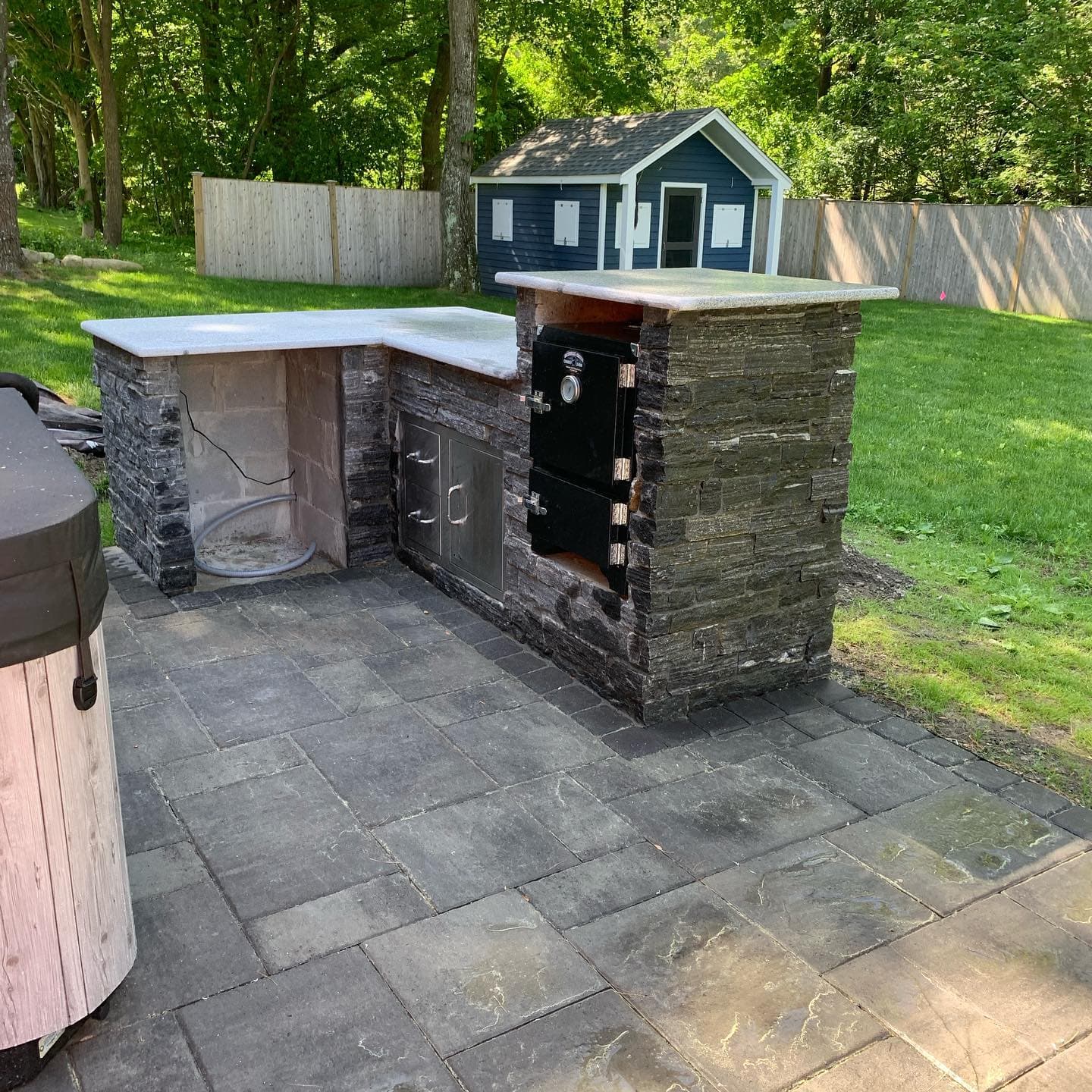
Pavers are made in molds, so every piece is consistent. That’s a strength. You can pick from dozens of colors, textures and sizes, lay them in a herringbone, a running bond or a random pattern, and add borders or a circle inlay. Newer large-format pavers have a smooth, stone-like face that reads almost like cut bluestone from a few feet away.
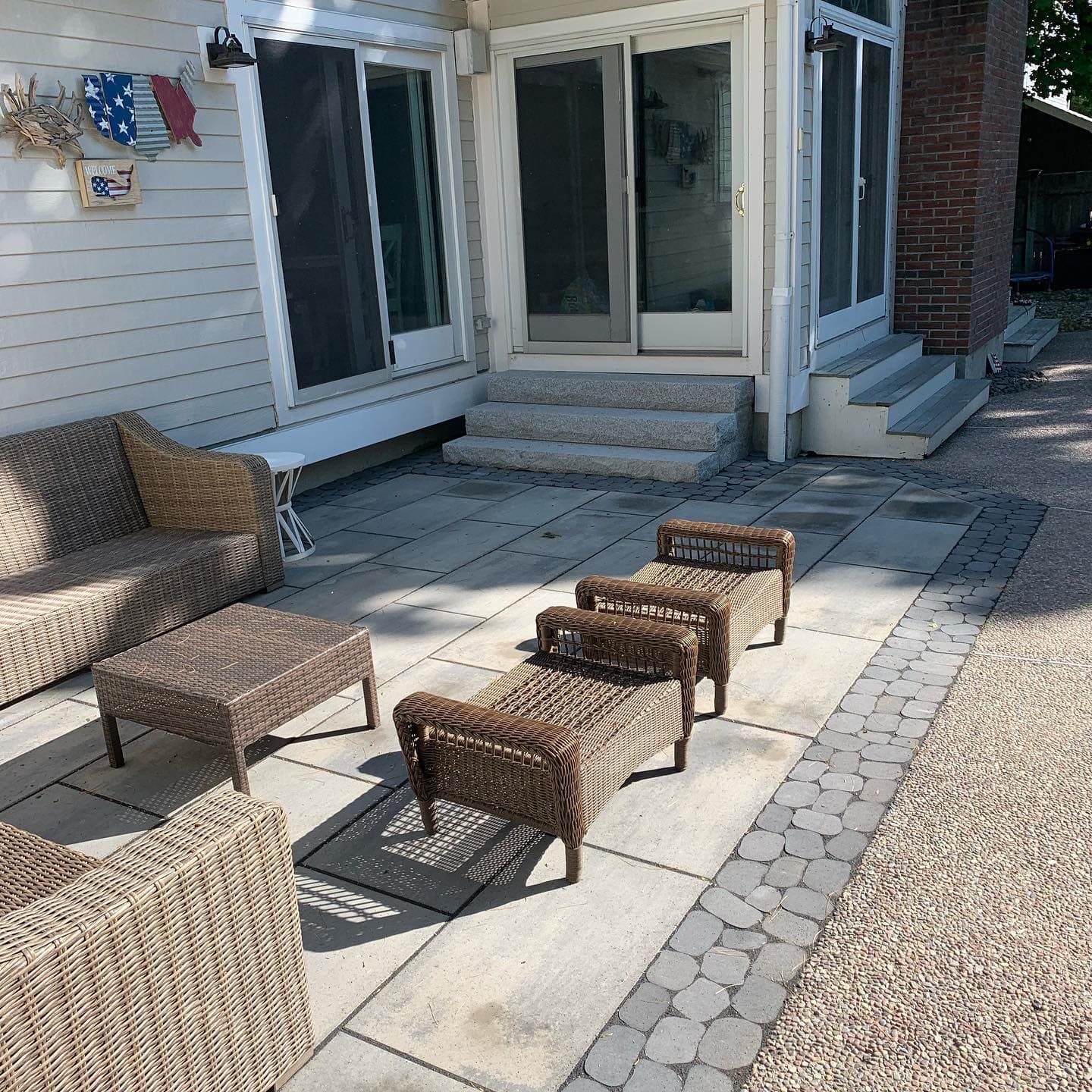
Bluestone is quarried, so no two pieces are exactly alike. The color shifts from blue-gray to lilac to rust in the same pallet. It can be laid in cut rectangles for a clean, formal look, or in irregular pieces for something more relaxed. On a colonial or a shingle-style house, bluestone often looks like it came with the place.
What Goes Under Them Matters More
This is the part that gets skipped in most comparisons. The surface you pick matters a lot less than what’s under it. A patio heaves, sinks or wobbles because of a weak base, not because someone chose the wrong stone.
Whichever material you choose, the build should look about the same underneath:
- Topsoil and organic material dug out, because they hold water and settle.
- Fabric over the native soil where the ground is soft or clay-heavy.
- A crushed-stone base laid and compacted in layers, not dumped in all at once.
- A slight pitch away from the house so water runs off instead of under.
- Edge restraint so the field can’t creep outward over time.
Pavers are set on a thin bedding layer and locked together with joint sand. Bluestone can be dry-laid the same way, or set on a concrete slab with mortar. Mortared bluestone looks sharp, but it needs a solid slab under it, and if the slab cracks, the joints crack with it. We’ll talk through which method fits your yard.
We go deeper on this in why patios heave after a New England winter.
Upkeep and Repairs
Pavers are the easier of the two to live with. If one settles or cracks, it can be lifted out and reset without disturbing the rest. Joint sand can wash out over the years and get topped up, and sealing brings back the color and helps keep weeds out of the joints.
Dry-laid bluestone behaves a lot like pavers: individual stones can be reset. Mortared bluestone is more permanent, which is good until something moves. Bluestone can also flake or spall in spots over many winters, especially where salt is used, so go easy with de-icers on it.
Heat, Grip and Comfort
Darker stone gets hot in full July sun, and bluestone runs darker than many pavers. If the patio sits in afternoon sun and you walk it barefoot, a lighter paver or a thermal-finish bluestone (a slightly rough, heat-treated surface) is more comfortable. Around pools, grip matters too. Textured pavers and thermal-finish stone both hold up well when wet.
Cost
We don’t publish prices, because the material is only part of the number. Digging, how far we have to carry material, access for equipment, steps and walls all change the price more than the stone itself. As a general rule, a standard paver patio costs less than natural stone, and mortared bluestone on a slab is at the higher end. If budget is the deciding factor, tell us. There’s almost always a way to get the look you want in a material that fits.
So Which One?
A rough guide:
- Pick pavers if you want lots of color and pattern choices, the easiest repairs, or the most patio for the money.
- Pick bluestone if the house calls for natural stone and you want that classic New England look.
- Mix them if you can’t decide. A paver field with a bluestone or granite border, or bluestone steps down to a paver patio, is a common and good-looking combination.
We bring samples of both to the site visit so you can see them next to your siding and trim in real daylight, not on a screen. See our patio work or call for a free estimate and we’ll walk the yard with you.